Choosing Fabric for a Pet Carrier: 600D, 900D, rPET and Vegan Leather
Fabric for a pet carrier is chosen against four properties buyers actually care about: water resistance, hair release, wipe-clean linings and a matte premium hand. This guide compares 600D and 900D Oxford, GRS-certified rPET and PU or microfibre leather, and sets out the lining, hardware and plating decisions that belong in the same specification.
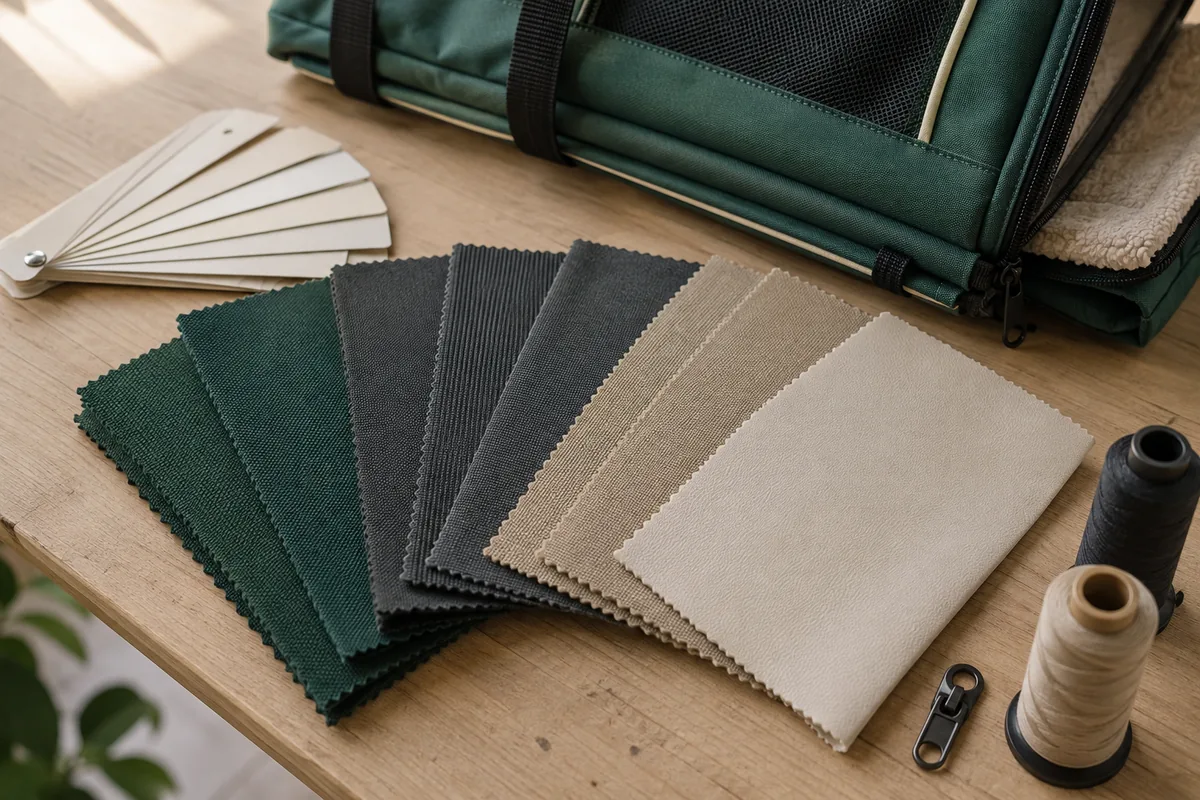
“We have hundreds of fabrics” is a useless answer to a buyer who asked for something premium, water-resistant and easy to clean. The useful answer names two or three constructions, explains what each gives up, and puts swatches in your hands. This guide is the shortlist we work from for pet carriers and travel bags, organized around the four properties buyers actually ask about.
The four properties that decide the fabric
Across pet bag inquiries the same four requirements come back, usually in this order:
- Water resistance. Almost every pet brief asks for it. A coating is what delivers it, not the base cloth.
- Hair release. Specific to pet products and rarely written into a spec, though it drives returns. A tight, smooth face sheds hair; a brushed or fleecy face holds it.
- Wipe-clean linings that survive repeat cleaning without cracking or delaminating.
- A matte hand. Premium positioning does not want a shiny face; this is a finish decision, not a fiber decision.
Organizing a specification around those four gets you a better bag than listing fabric names, because it tells the factory what to protect when a trade-off has to be made.
The main options
| Construction | Where it fits | Trade-off |
|---|---|---|
| 600D Oxford, PU coated | The usual baseline for everyday carriers and travel bags: light, water-repellent, cost-efficient | Less body and less abrasion resistance than heavier cloth |
| 900D Oxford | Firmer hand, better abrasion resistance, holds structure on larger bags | More weight and more cost |
| 1680D | Heavy-duty panels and high-wear bases | Stiff; rarely right for a whole bag |
| GRS-certified rPET Oxford | Sustainability positioning; performs close to standard Oxford and the mill's certificate can be supplied for your product page | Color range and dye-lot minimums are tighter than virgin polyester |
| PU or microfibre leather | Handbag-style carriers over a structured base | Needs a considered cleaning and abrasion story; not for heavy outdoor use |
| Canvas, nylon, mesh, fleece, faux fur | Trims, ventilation panels, comfort liners and pads | Chosen per panel rather than for the whole bag |
A combination that has worked repeatedly for premium pet travel bags is a roughly 330 g/m² polyester with a PVC back-coating in a deep charcoal or graphite: matte, with real body, abrasion-resistant, available in a water-repellent version, and a tight enough face that dog hair does not cling to it. Exact GSM and coating are confirmed against the specific fabric you choose rather than quoted from memory.
Linings are a separate decision
The lining takes the abuse, so it deserves its own line in the specification. Two constructions cover most pet bags:
- Matte coated polyester lining for the main compartment — wipeable and noticeably more premium in the hand than a foil liner.
- Waterproof aluminium-film lining for a removable dirty-gear or wet pocket, where damp resistance matters more than looks.
Using both, each where it belongs, beats using one everywhere. If a pocket is intended to hold treats, say so early: food-contact suitability is a test on a specific material (FDA in the United States, LFGB or EU 10/2011 in Europe), and it is not something to claim without the report.
Hardware, zippers and plating
Premium briefs are usually decided at the hardware before the fabric. We specify in three tiers — entry (domestic zippers, standard plating), mid, and premium (YKK, solid hardware, special plating) — and the checkable claim is the plating, not the adjective: our electroplating is lead-free and nickel-free and passes salt-spray testing. For buyers who need it documented, ASTM B117 salt spray on the hardware, AATCC 8 or ISO 105 for color fastness and ASTM D2061 or D2062 for zipper strength can be commissioned from a third-party laboratory; method, sample count, acceptance criteria and cost are agreed before testing starts. See the quality control checklist for how those tests fit into an inspection plan.
Structural components worth naming
- Mesh grade. A ventilation panel that must resist scratching and biting, close fully and stay open without collapsing is a different mesh from a decorative one.
- Base construction. Aluminium frame, PP base board and non-slip silicone feet are the normal answer for car seats and larger carriers.
- Bubble windows. Available in PC or PETG, chosen on clarity, weight and impact.
- Removable dividers and modular liners. Hook-and-loop, snaps and side-release buckles differ in holding power and in how they feel to the end user; we will tell you which suits the load.
- Padding. Memory foam and orthopaedic pads, and interchangeable mattress options, are specified per model.
How to run a swatch round efficiently
Send three things and the shortlist arrives in one round instead of four: the use case, the positioning, and your target retail price. From those we propose two or three directions and send swatches, because hand feel is not a parameter you can read. Colors are then matched to Pantone across fabric, thread, webbing and hardware, and the confirmed fabric, coating, GSM and color references become part of the approved sample record described in our custom order FAQ. Bring the fabric decision forward if a Chinese New Year shutdown is anywhere near your timeline — dye lots are the first thing to go.
Is 900D always better than 600D?
No. It is firmer and more abrasion-resistant, and it is heavier and dearer. For an everyday carrier that sits under an airline seat, 600D with a PU coating is usually the better product, not just the cheaper one.
Does rPET perform worse than standard Oxford?
In practice they are close for pet bag use, and the certified recycled content is a genuine selling point. Plan the color range earlier, because dye lots are less flexible.
Can you match a fabric I already sell?
Yes. Send a swatch or the existing bag and we source against it, or work from your nominated mill and trims; we also accept customer-specified fabrics and accessories.
Which fabric hides dog hair best?
A tightly woven, coated, matte face — the 330 g/m² PVC-backed polyester above is the usual answer. Avoid brushed or fleecy outer faces on anything a shedding dog will sit against.
Eland Bag also manufactures wholesale pet carriers and travel bags and OEM pet backpack carriers at the same MOQ, so one factory can supply a complete travel range.