IATA Pet Carrier Requirements: What an OEM Buyer Must Verify Before Sampling
IATA guidance and an airline's own current policy are inputs to an OEM brief, not a universal approval label. Before sampling, define the target flight scenario, convert the relevant rules into measurable carrier specifications, verify them on the physical sample, and keep customer-facing claims tied to the airline and route actually checked.
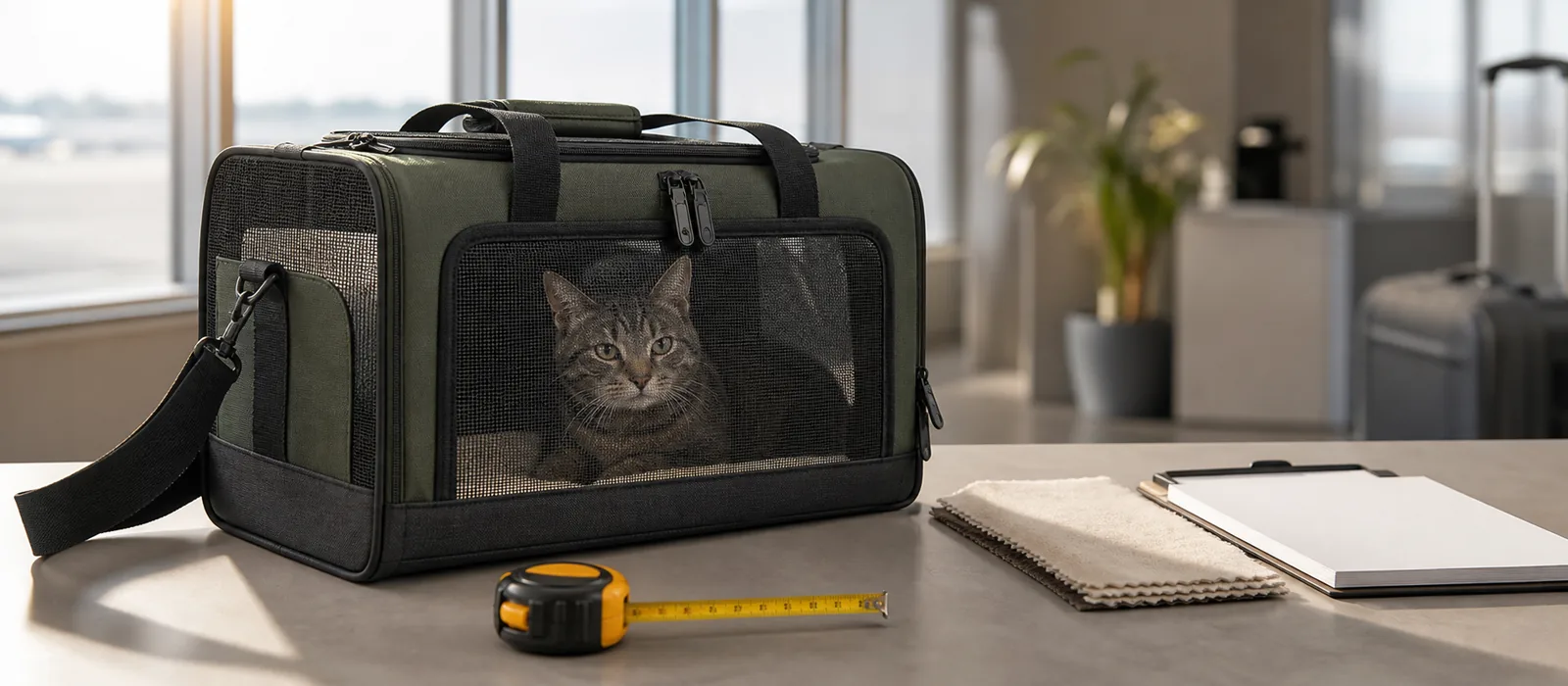
This guide is for brand owners and wholesale buyers sourcing a soft-sided airline pet carrier. It covers the verification chain that should happen before sample approval: rule source, product specification, sample evidence and listing language.
IATA guidance and airline policy have different jobs
IATA's current Traveler's Pet Corner explains transport preparation and container suitability, including space for an animal to stand, turn, sit and lie naturally. The operating airline decides whether it accepts a pet on a particular flight and cabin, and publishes its own limits. For example, American Airlines' pet policy distinguishes carrier types, aircraft and seating constraints. Neither source creates a global "airline-approved" certification for a product.
Source check: IATA Traveler's Pet Corner and American Airlines Pets policy were accessed on August 11, 2026. Recheck the operating airline's official page for the booked itinerary before production sign-off, listing publication and travel.
Build one verification chain before sampling
| Stage | Buyer input or evidence | What the factory should freeze |
|---|---|---|
| 1. Rule source | Official IATA guidance plus the operating airline's current pet and cabin policy | Airline, route, cabin, aircraft where known, travel date and source URL |
| 2. Product specification | Required external envelope, usable interior space, ventilation, closure and base needs | Controlled drawing, bill of materials and claim wording |
| 3. Sample validation | Measured, loaded and closed sample with photos and a signed review record | Approved dimensions, tolerances and construction details |
| 4. Listing and label review | Claims compared against the evidence and the named airline policy | No universal-approval or unverified compatibility claim |
Translate the rules into product specifications
Start with the operator's official policy, then make each requirement testable in the product brief. Under-seat space, cabin access and pet limits may differ by aircraft or seat. A soft carrier that fits when empty can still exceed its usable envelope if the base sags, the frame bows or the packed carrier cannot close securely.
| Spec Area | What to Ask the Factory | Why It Matters |
|---|---|---|
| Dimensions | External length, width and height; internal usable space; loaded compression behavior | Links the sample to the named operator's current limits without treating one size as universal |
| Ventilation | Mesh sides, placement, coverage, seam reinforcement and airflow when the bag is loaded | Keeps the design review focused on animal comfort and the operator's stated requirements |
| Escape prevention | Closure path, zipper-pull interaction, mesh-to-fabric seams, gaps and hardware retention | Lets the buyer specify what must remain secure during normal use; it is not a claim that no escape is possible |
| Structure | Base stiffness, removable pad, lining, handle attachment and expected loaded shape | Shows whether the sample holds its specified form under the intended use condition |
| Label language | Named airline, source date, route/cabin limits and consumer instruction to reconfirm | Prevents marketing from turning a checked scenario into a blanket approval promise |
Verify ventilation, escape prevention and structure on the sample
Do not approve from product photos alone. Measure the closed sample in three directions, then repeat the measurement in the intended loaded condition. Review mesh seams, zipper corners, closure engagement, handle attachments and the base insert. Record the condition, tools used, observed dimensions, reviewer and photos. If a buyer requests load, zipper, waterproof, drop or corrosion testing, define the method, sample count and acceptance criteria before arranging the work through a qualified third party; do not label an unreported test as passed.
Keep customization inside the checked specification
Color, logo position, zipper pulls and packaging can be developed after the functional brief is clear. Changes to the pattern, mesh coverage, base, frame or windows need another rule-to-sample review because they may change ventilation, security or the loaded envelope. Use the airline pet carrier platform as a starting point, then confirm the final construction against the selected airline scenario.
Review supplier documents and customer-facing language separately
Ask early which material documents apply to fabric, mesh, lining, plastic parts and packaging; market requirements such as REACH or California Prop 65 should be scoped to the finished product and destination. Keep those documents separate from airline eligibility. A product listing may say that a sample was designed around a named, date-checked airline scenario only when the evidence supports it. It should also direct travelers to confirm their airline's current rules, because acceptance can depend on the itinerary, aircraft, cabin, seat and staff assessment.
Questions to ask before sample approval
- Which operating airline, route, cabin and aircraft assumptions are in scope?
- Which official policy URLs were checked, and on what date?
- What are the specified external and internal dimensions, including the loaded condition?
- Where are the ventilation panels, and which seams and closures must be reviewed?
- Which tests, if any, require a third-party plan before production?
- Which exact statements are allowed on the product page, packaging and customer-service script?
Eland Bag's standard MOQ is 300 pcs per style per color. Samples normally take 3–7 days after the relevant requirements are confirmed; project timing and any special validation work should be confirmed in the quotation. See our OEM/ODM services for the development workflow.
Use the size guide and QC checklist together
For a repeatable dimensions matrix, start with our airline pet carrier size guide for OEM buyers; it is the site page dedicated to size-source comparison. For a pre-test brief and evidence record, use the pet carrier quality-control checklist. Then send Eland Bag the named airline sources, target dimensions, expected pet profile, customization details, order quantity and destination through the inquiry form.
FAQ
Does IATA make a carrier airline-approved?
No. IATA provides transport guidance, while the operating airline decides acceptance under its current policy and the actual itinerary. Avoid a universal approval claim.
Can a soft carrier be slightly larger than a stated limit?
Only rely on what the relevant airline's current policy says for the planned journey. A flexible design still needs to fit under the seat as required, and the sample must be checked in its loaded condition.
What is the most useful OEM evidence?
A controlled specification, dated source links, measured sample record, clear photos and approved claim wording provide a stronger basis than a generic compatibility statement.
Build the Rest of Your Pet Bag Sourcing Plan
These guides connect product selection, supplier checks and landing-page SEO so your catalog can rank and convert as a full sourcing cluster.
OEM Pet Carrier Sourcing Checklist
A practical buying framework for choosing products, materials, factory checks, MOQ and launch planning.
Read Guide →Dog Hiking Backpack Wholesale Guide
How to spec trail saddle packs and dog carrier backpacks for outdoor pet customers.
Read Guide →Eland Bag also manufactures wholesale pet carriers and travel bags and OEM pet backpack carriers at the same MOQ, so one factory can supply a complete travel range.