Pet Carrier Quality Control Checklist for OEM Buyers
A useful pet carrier quality control checklist connects the approved sample to measurable production checks: dimensions, materials, closures, seams, load points, ventilation, packaging and labeling. Define the sampling plan and defect classes before production, inspect during manufacturing, and release the shipment only when the report matches the purchase specification.
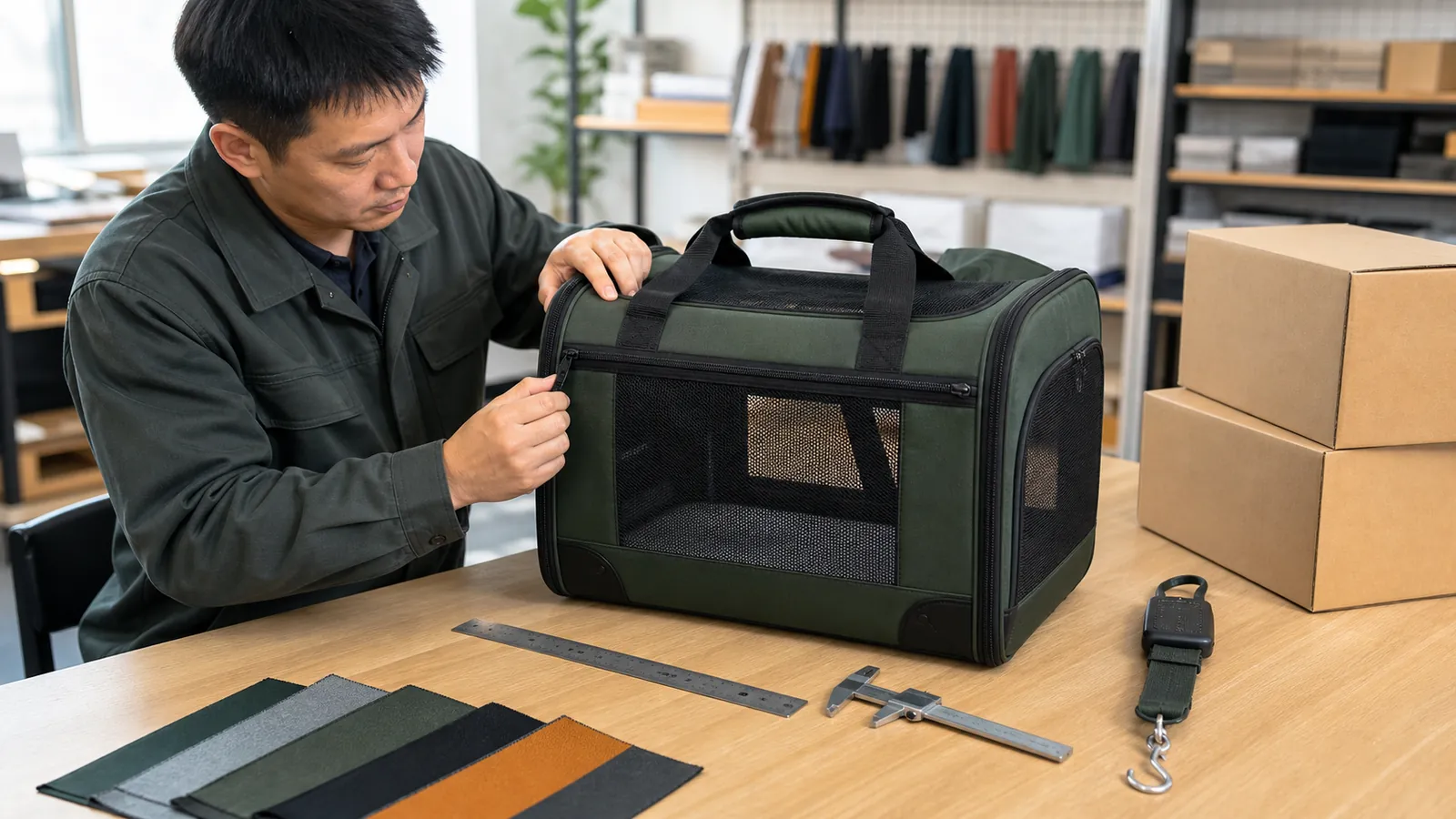
Pet carrier QC fails when the order says only “good quality.” A factory cannot inspect a preference that was never converted into a tolerance, test method or reference sample. The buyer should build the quality file while confirming the product brief, then attach its latest version to the purchase order. This is the inspection layer that follows the broader OEM pet carrier sourcing process.
What belongs in a pet carrier quality file?
The quality file is the shared definition of an acceptable shipment. It should identify the approved sample, bill of materials, drawings, labeled dimensions, workmanship limits, packaging specification and test methods. A photo can show shape and color, but it cannot define a seam allowance, zipper cycle count or acceptable measurement range. How the approved sample and inspection stages work commercially is summarized in our custom order FAQ.
| Control Document | What It Fixes | Buyer Evidence |
|---|---|---|
| Approved sample | Construction, hand feel, color and workmanship benchmark | Signed or sealed sample ID and approval date |
| Specification sheet | Dimensions, tolerances, component positions and intended load | Revision-controlled drawing with measurement points |
| Bill of materials | Fabric, mesh, foam, board, zipper, webbing and hardware | Material codes, colors and approved substitutes |
| Inspection plan | Sampling, defect classes, tests and release rule | Agreed inspection level, AQL values and report format |
A soft-sided pet travel carrier specification will emphasize frame shape, mesh, base support and closures. A pet carrier backpack design also needs strap symmetry, load distribution and attachment-point checks. One generic checklist cannot replace product-specific risks.
How should an AQL sampling plan be written?
AQL is a decision tool, not a promise of zero defects. The current ISO 2859-1:2026 standard defines acceptance-sampling plans for inspection by attributes and uses the acceptance quality limit to determine sample sizes and acceptance or rejection thresholds. It replaced the 1999 edition in January 2026.
Before inspection, the buyer and supplier should agree on the lot definition, inspection level, sampling scheme, AQL for each defect class and what happens after rejection. Do not copy an AQL number from another product without considering market risk. The contract should also define any feature that receives a 100% check independently of the random sample.
| Defect Class | Pet Carrier Example for Buyer Review | Required Decision |
|---|---|---|
| Critical | Exposed sharp point, closure opens during intended use, or required safety part missing | Define unacceptable conditions and escalation in advance |
| Major | Broken zipper, detached load-bearing seam, wrong size, severe base distortion | Set the agreed AQL and reinspection route |
| Minor | Small cosmetic issue that does not impair intended function | Set objective appearance limits with photos |
These are classification examples, not universal legal definitions. The importer or brand owner remains responsible for deciding what is critical for the product, claims and destination market.
Which functional tests should buyers specify?
Inspection must test how the carrier is intended to work, not only how it looks on a table. Test conditions, loads, cycle counts, conditioning and pass/fail criteria should be written into the specification. The OEM/ODM development workflow should confirm these methods at sample stage so bulk inspection does not introduce a new standard after production.
Dimensions, materials and appearance
Measure the internal and external length, width and height at named points. Check pocket, opening and strap dimensions where customer fit depends on them. Match fabric, mesh, webbing, foam, board, hardware and color to the approved bill of materials. Record shade variation, print placement and logo position with tolerances rather than subjective comments.
Closures, seams and ventilation panels
Operate every sampled zipper through the agreed cycle test and inspect slider travel, end stops and surrounding seams. Apply the specified force to buckles, clips and internal tethers in their intended direction. Mesh should be checked for tears, skipped stitches, unsecured raw edges and openings that differ from the drawing. Inspectors should pay particular attention to corners where zipper tape, piping, mesh and shell fabric meet.
Handles, straps and base support
Load the carrier using a controlled test mass and the approved method; do not test with a live animal. Observe handle elongation, seam movement, buckle slip, backpack-strap symmetry and base deflection. After testing, reopen the carrier and inspect hidden attachment points. A product can look undamaged while stitching inside a binding has already started to separate.
When should inspection happen?
Final inspection alone is too late to discover that the wrong mesh or reinforcement was used across the lot. Use at least three control points:
- Pre-production: freeze the sample, specification, materials, packaging and test plan.
- In-line inspection: check first finished units and work in progress while corrective action is still practical.
- Pre-shipment inspection: draw the agreed random sample from completed, packed production and make the release decision.
Buyers who want to understand the production checkpoints can review the factory and quality-control process. Any approved deviation should be documented by revision, quantity and responsible approver rather than accepted through an informal chat message.
How should packaging be checked?
QC should inspect the sellable unit and its transit packaging together. Confirm folding method, mesh protection, accessory count, barcode readability, polybag or carton dimensions, carton quantity and shipping marks. The International Safe Transit Association test-procedure library distinguishes screening, partial-simulation and general-simulation protocols; ISTA 3A, for example, applies to individual packaged products up to 70 kg moving through parcel systems. Select a protocol that matches the actual pack and distribution route instead of claiming every carton is “drop-test approved.”
What changes for airline-oriented carriers?
Do not print “airline approved” as if one design guarantees acceptance everywhere. IATA says its Live Animals Regulations address factors including ventilation, container suitability and animal welfare, while governments and operators set or enforce additional rules. The 2026 edition took effect on January 1, 2026. Use the current IATA live-animal guidance, then verify the destination and airline before finalizing claims. Our airline pet carrier OEM guide explains how to turn that variability into a sampling brief.
Where does material compliance fit?
Physical inspection cannot prove chemical compliance. Link the tested sample to the material supplier, color and production batch, then retain declarations and laboratory reports appropriate to the destination market. ECHA explains that Candidate List substances in articles can trigger duties for importers, producers and suppliers, and that supply-chain information is a key source for material composition. Review the ECHA requirements for Candidate List substances in articles and use our pet carrier compliance document checklist to organize buyer records.
What should the final inspection report show?
The report should identify the PO, SKU, lot size, packed quantity and sample size; list defects by class; record measurements and functional results; show packaging and carton checks; attach clear photographs; and state pass, fail or hold. If units are reworked, the report should describe the correction and the agreed reinspection method. A report without traceable quantities and a release decision is only a photo album.
Buyer checklist before issuing the PO
- ✓Reference one approved sample and one current specification revision.
- ✓Define defect classes, sampling plan, AQL values and any 100% checks.
- ✓Write test loads, cycles, tolerances and pass/fail criteria.
- ✓Connect material evidence, packaging and labels to the same SKU.
- ✓State who can release, hold, rework or reinspect the shipment.
When your quality file is ready, send the specification, quantity and destination market through the pet carrier OEM inquiry form so the quotation and sample plan can follow the same requirements.
Frequently Asked Questions
Use these answers to align the buyer, factory and inspection team before bulk production.
What does AQL mean in pet carrier inspection?
AQL means acceptance quality limit. In an agreed sampling plan, it helps determine sample size and acceptance or rejection thresholds for a lot. Define the inspection level, defect classes and AQL values in the purchase agreement rather than asking for a generic “AQL inspection.”
Which pet carrier defects should be classified as critical?
A critical defect creates an unacceptable safety or regulatory risk. The buyer must define this for the product and market. Examples for review may include a closure that opens under intended use, an exposed sharp point or a required safety component that is missing.
Does AQL inspection mean every pet carrier is tested?
No. Acceptance sampling examines a defined random sample from the lot. A separate control may require a 100% check of a high-risk feature, but that requirement must be written into the quality plan.
What is the difference between an approved sample and a shipment sample?
The approved sample records the accepted design, materials, dimensions and workmanship before bulk production. A shipment sample comes from finished production and shows what was actually made. Inspectors should compare production with the approved specification, not rely on memory.
What should a pet carrier pre-shipment report include?
It should identify the PO and lot, sampling plan, quantities checked, defect counts by class, measurement and functional-test results, packaging checks, photographs, corrective actions and a clear release or hold decision.
Eland Bag also manufactures wholesale pet carriers and travel bags and OEM pet backpack carriers at the same MOQ, so one factory can supply a complete travel range.